

Author: Melanie Bennet
Alberta taxpayers saved a massive $1.35 billion over the last five years due to independent and homeschool options, with 2024 alone totalling $306 million in savings, according to a new report from the Aristotle Foundation for Public Policy.
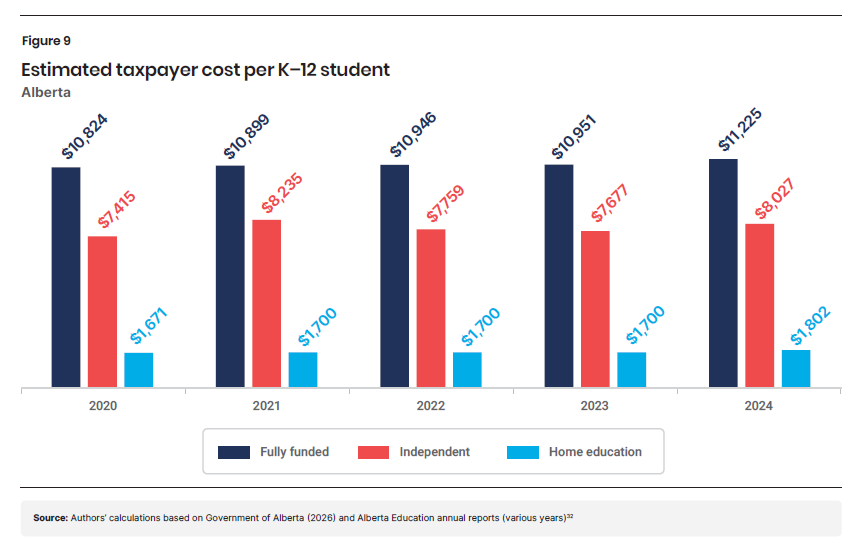
The statistics speak for themselves. Fully funded public system students cost taxpayers an average of $11,225 per year, compared to $8,027 for independent school students and just $1,802 for home-educated students. That difference translates into annual savings of roughly $3,200 per independent student and more than $9,400 per homeschool student.

According to the report, the student population has grown 31 per cent across all schools since 2011, with fully funded schools taking on 90 per cent of students. Mass immigration has added to these pressures.
In a televised address, Danielle Smith declared that mass immigration has “flooded our classrooms, emergency rooms, and social support systems with far too many people far too quickly.”

Smith says Alberta’s student population has “skyrocketed” by more than 80,000 students in the last four years. Overall, the province has gone from 114,000 English-language learner students in 2020 to 136,000 in 2021, with the number of refugee students rising from 10,000 to 14,000.
That increase in student population, especially among those requiring additional supports, is costly. While independent and homeschooled students account for a much smaller share of the education budget than their share of enrolment, they receive partial or minimal operating funding and no capital funding at all.
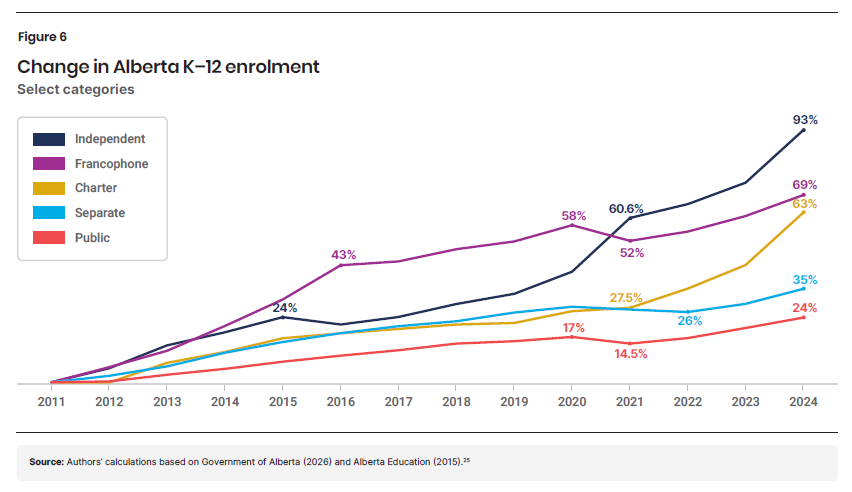
Independent and homeschooled students now represent 6.7 per cent of Alberta’s K–12 enrolment. Independent enrolment has grown 93 per cent since 2011, while homeschooling has nearly tripled.
The study also models a scenario few provinces would dare to test: If every independent and home-educated student entered the public system tomorrow, Alberta would need at least 54 additional schools. The estimated capital cost would be roughly $1.76 billion, not including an additional $306 million in annual operating costs.
Independent schools are distinct communities, often catering to specific religions or denominations, and they are growing in innovative ways. “For instance, you can find numerous independents that have ten-exed enrolment in just the last decade without increasing their physical footprint. Whether it is supervising home-based programs, hybrid schooling, or other innovative approaches that allow for flexibility for families while maximizing limited resources, there is a problem-solving, entrepreneurial spirit to these schools,” according to Hunt. “That kind of culture attracts growth.”

Albertans are already feeling the squeeze, as schools in Calgary and Edmonton are operating at or above capacity in many areas. For some, overcapacity signals underfunding — funding they argue independent schools divert from the public sector.
Hunt disagrees. “If you buy groceries at Save-On Foods, have you taken money away from Superstore?” Accredited funded independent schools in Alberta receive approximately 70 per cent of the per-student operating grant provided to fully funded public schools and receive no capital funding for school construction.
While the “anti-independent crowd,” as Hunt calls them, claims cutting funding to independent schools would “generate larger savings,” the report predicts with “near certainty” that the opposite is true. Families who choose alternative models are still taxpayers, and cutting funding would “force tuition to a rate that most couldn’t afford,” says Hunt, as in Alberta these families are “overwhelmingly middle income.”
When they opt into partially funded systems, they help relieve operating and infrastructure pressures as Smith works to address the province’s “unsustainable budget deficits.”
“Ironically, the funding cut would increase the taxpayer burden, due to student migration.” Hunt believes that “so long as independent schools are only partially funded, every independent student costs taxpayers less—i.e., saves Albertans money.”