


Author: Alex Dhaliwal
Conservative MP Michelle Rempel Garner fired back at a CTV host who brought up a significantly smaller surge in temporary foreign workers under Stephen Harper, demanding to know why he was scrutinizing the Conservative government from well over a decade ago instead of Mark Carney.
The spat happened on the November 6 broadcast of Power Play, when host Michael Couture confronted Rempel Garner about the increase between 2006 and 2013 when faced with Carney’s record immigration proposal.

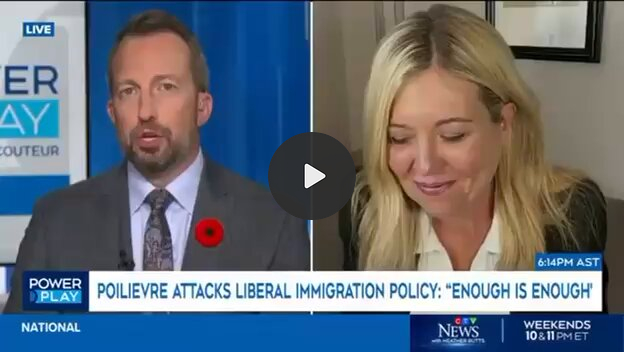
Couture asked whether former Prime Minister Stephen Harper’s Conservatives contributed to Canada’s reliance on temporary foreign workers amid housing and job pressures criticized by Rempel Garner.
“Dude, 2006 called,” Rempel Garner shot back. “Why are you guys asking me about 2006?”
Couture reminded her that she was elected in 2011 and served in Harper’s government.
“I reject everything you just said because wages kept pace with inflation back then,” Rempel Garner responded.
“Rent was half the price,” she continued, adding that young Canadians once had a realistic chance of buying a home after college.
“Why are you holding me to account more than Mark Carney on this issue?” she demanded.
Couture became defensive, saying journalists regularly question the Liberal government and that previous Conservative immigration policies also warranted scrutiny.
He said if Rempel Garner was going to blame the Justin Trudeau Liberals for the state of Canadian immigration, then she should be equally willing to answer questions about the policies Harper’s government adopted.
“That was 20 years ago,” Rempel Garner replied, before stating that Carney had just announced “the highest level of permanent immigration in Canadian history.”
The Harper government’s 2014 Temporary Foreign Worker Program review shows that the total number of TFWP and International Mobility Program permit holders in Canada rose from 160,724 in 2006 to 386,406 in 2013 (an increase of about 140 per cent — over 7 years).
Those figures are workers present in Canada on December 1 of each year (i.e., they’re not annual arrivals).
In comparison, the government’s 2014 announcement reported a 29 per cent increase in annual entries under the narrower employer-approved Temporary Foreign Worker Program, from about 65,000 in 2006 to 84,000 in 2013.
Harper’s Conservatives also introduced wage flexibility in 2012, permitting certain employers to pay foreign workers below the prevailing rate for that occupation.
The government reversed course in 2013 and tightened the program in 2014 in response to controversy over employers using foreign workers and concerns that Canadian workers were being displaced.
This tightening was immediately reversed under Canada’s next PM, Justin Trudeau.
Temporary migration expanded under the Trudeau Liberals. Budget 2026 reports 971,815 new temporary resident arrivals in 2023 and 686,010 in 2024 (including foreign workers and international students).
Carney’s 2027–2029 Immigration Levels Plan targets 370,000 new temporary resident arrivals annually, alongside 380,000 permanent resident admissions.
The regular permanent resident target is below the record 483,655 admissions recorded in 2024. However, that’s only because much is left out.
Budget 2026 targets 370,000 new temporary resident arrivals in 2027, excluding asylum seekers, while an immigration lawyer estimates permanent resident admissions could potentially reach 662,000.
This is because the government also announced additional PR admission space for up to 200,000 people already in Canada in 2027.
That’s up to 100,000 workers and their families, plus a humanitarian cohort of up to 100,000 people (which would include those already on the list and those with longstanding ties to Canada).
Unlike the regular annual immigration targets, these are additional, time-limited admissions spaces. This could push total permanent residence admissions well above the 2024 record, depending on how many applications are approved and finalized.
Meanwhile, Budget 2026 commits $151.5 million over five years to reform the Temporary Foreign Worker Program.