

Author: Alex Dhaliwal
Hours after the release of a bombshell government diary, Dr. Anthony Fauci repeatedly pleaded the Fifth before a U.S. Senate committee Tuesday, refusing to answer lawmakers’ questions more than 100 times under subpoena.
“Although it pains me to do so... under the advice of my attorneys, I will invoke my right under the Fifth Amendment of the Constitution to refrain from answering your questions,” Fauci, 85, said in his opening statement before the Senate Homeland Security and Governmental Affairs Committee.


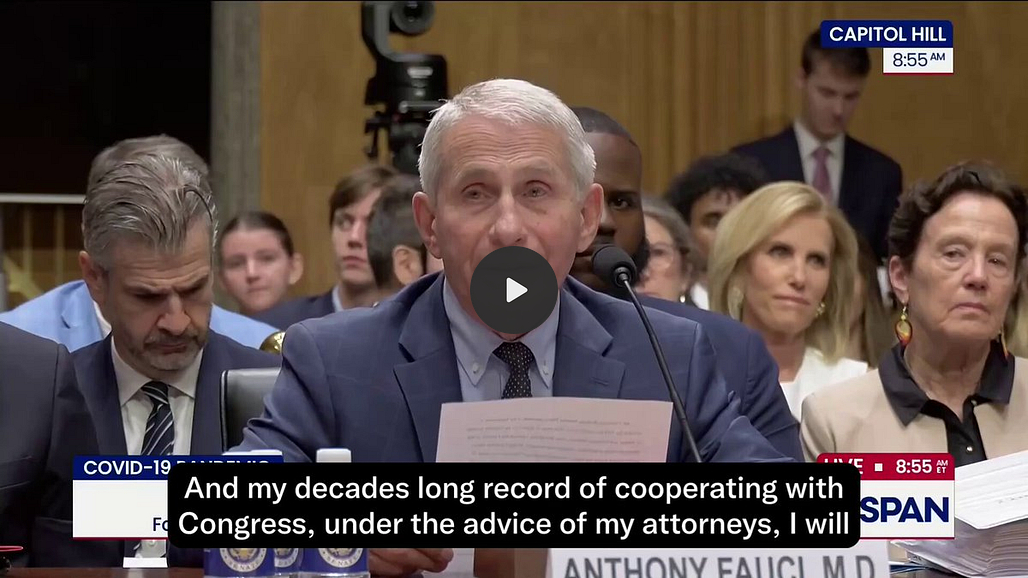
For the rest of the hearing, the former director of the National Institute of Allergy and Infectious Diseases (NIAID) answered question after question with the same response: he would not testify, citing his Fifth Amendment right against self-incrimination.
The Fifth Amendment states that no person “shall be compelled in any criminal case to be a witness against himself.”
Fauci received a sweeping preemptive pardon from former President Joe Biden in 2025 covering potential federal offences tied to his government service during the pandemic.
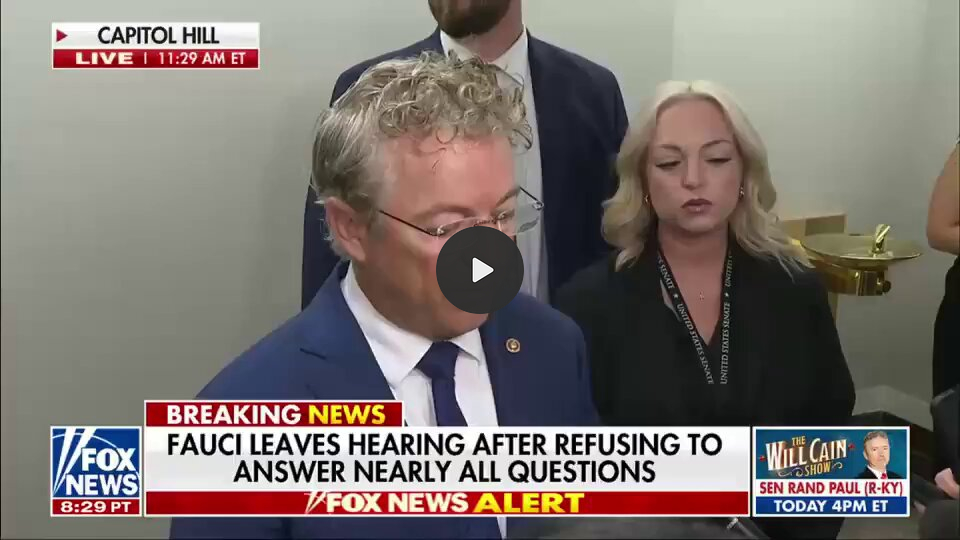
Despite that pardon, Sen. Rand Paul (R-Ky.), who chairs the committee, said lawmakers will vote next week on whether to recommend criminal contempt charges after accusing Fauci of defying a valid congressional subpoena.

“We believe that with his immunity from criminal liability, that he didn’t need to hide behind the Fifth Amendment, and that maybe the Fifth Amendment doesn’t attach when you have a pardon in place,” Paul told reporters after the hearing.
Federal law makes it a crime for a witness subpoenaed by Congress to refuse to answer pertinent questions, although whether the Fifth Amendment privilege remains available after a presidential pardon is a legally disputed question that has not been definitively settled by the courts.

The dramatic hearing came one day after Paul released a diary Fauci kept while overseeing the federal government’s pandemic response.
Among the most explosive entries was a March 2020 account in which Fauci wrote that he personally persuaded then-New York City Mayor Bill de Blasio to shut schools.

“I convinced him based on what I was saying publicly and my conversation tonight to close the NYC schools,” Fauci wrote.
In another entry, Fauci described speaking with California Gov. Gavin Newsom’s chief of staff, who told him the governor decided to close California schools, bars and restaurants based on Fauci’s television appearances.
The diary appears to conflict with Fauci’s repeated public claims that he was not responsible for school closures.

Paul also pointed to diary entries describing an early February 2020 conference call with prominent scientists about the origins of COVID-19.
According to Fauci’s notes, nine of the 11 scientists on the call believed it was possible the virus’s furin cleavage site had been inserted by humans.
Paul argued that assessment is significant because a later-publicized research proposal described plans to insert a furin cleavage site into bat coronaviruses in experiments that could have been conducted in China.
“This was either an extraordinary coincidence or a smoking gun,” Paul said Monday while releasing the diary.
Throughout the pandemic, Fauci consistently maintained that COVID-19 most likely emerged naturally and repeatedly denied that his agency funded gain-of-function research.

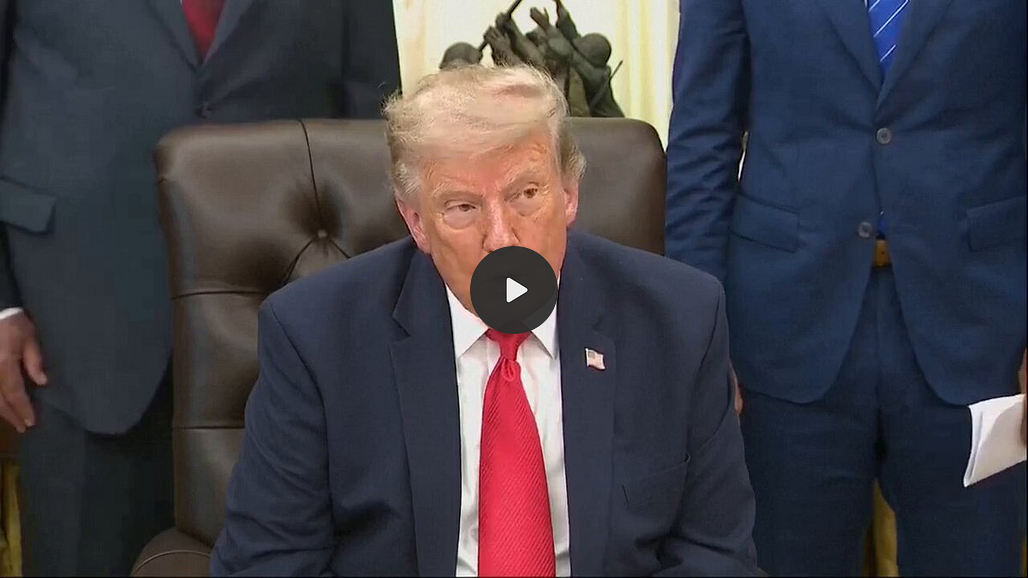
Former President Donald Trump weighed in on the controversy Monday, writing on Truth Social that he had “always said” the virus came from a laboratory in Wuhan and accusing Fauci of trying to protect China.
Meanwhile, a federal inspector general previously concluded that NIAID funded risky research at a Wuhan laboratory and found federal oversight of those experiments was inadequate.
“Your primary concern was hiding the fact that you approved funding for this dangerous research,” Paul told Fauci during Tuesday’s hearing.

Fauci’s attorney, David Schertler, was removed from the hearing after attempting to address senators during the proceedings.
Democrats dismissed the Republican-led investigation as politically motivated. Sen. Gary Peters (D-Mich.), the committee’s ranking member, argued Paul’s inquiry was driven by a predetermined conclusion and said Congress should instead focus on preparing for future public health emergencies and overseeing current federal health policy.

But Fauci’s repeated refusal to answer questions reverberated beyond Washington.
Former Conservative MP Dean Allison said the hearing vindicated many Canadians who challenged pandemic policies, arguing that “things were done wittingly wrong during the pandemic in Canada as well, similar to the U.S.”
Allison called for apologies to those “who were ostracized, blamed and cancelled” for questioning public health measures, and urged accountability for “politicians, bureaucrats and media who dictated and coordinated their flagrant decrees at the expense of the people.”
At the onset of the pandemic the effectiveness of masks favored by the public for cost, comfort, and availability, could easily be ascertained by asking a simple question that the corrupt legacy media couldn't conceive of, and certainly wouldn't report.
One can easily extrapolate the effectiveness of lesser masks worn by virtually the entire population by the fact a coronavirus (0.125 microns) has a smaller diameter than what the better N95 (0.3) is rated for.
After my piece which I believe someone misrepresented, USA Today carefully and dishonestly focused on N95 masks, which few people had access to in order to avoid the crushing reality that the remaining inferior masks below a 95, especially cotton, are equivalent to wearing a placebo.
https://pmc.ncbi.nlm.nih.gov/articles/PMC4420971/
https://eu.usatoday.com/story/news/factcheck/2020/06/11/fact-check-n-95-filters-not-too-large-stop-covid-19-particles/5343537002/
I was pleased to see the USA Today article and used it as evidence of how MSM lies by omission.
I don't require vindication since my assertions on masks and the gene therapy shot, repackaged as a vaccine, were as irrefutable then as they are now.
Note that the mask study was not only the best available to date at the time, but untainted from political interference, right up to researchers who were willing to falsify data. An example can be referenced below from another piece.
A partial repost on HCQ. Ideological morons protect their dogma with religious zeal, vehemently attacking those that threaten it in a manner akin to blaspheming Muhammad with a picture. Consider the now fashionable theory that COVID-19 came from a lab in Wuhan that was "thoroughly debunked" or the hysteria around the safety of a drug that has been used for over sixty years magically became much too dangerous. In both cases, truth was sacrificed by the corrupt leftist media and researchers, to discredit Trump. The Washington Post quietly admitted, I mean passed on the blame, to Lancet. The study cited was apparently what the leftist media based their "science" on.
"Editor’s note: This study was retracted on June 4 by three of its authors who said they could “no longer vouch for the veracity of the primary data sources.” The notice was posted by the medical journal Lancet."
https://www.washingtonpost.com/health/2020/05/22/hydroxychloroquine-coronavirus-study/