

Author: Alex Dhaliwal
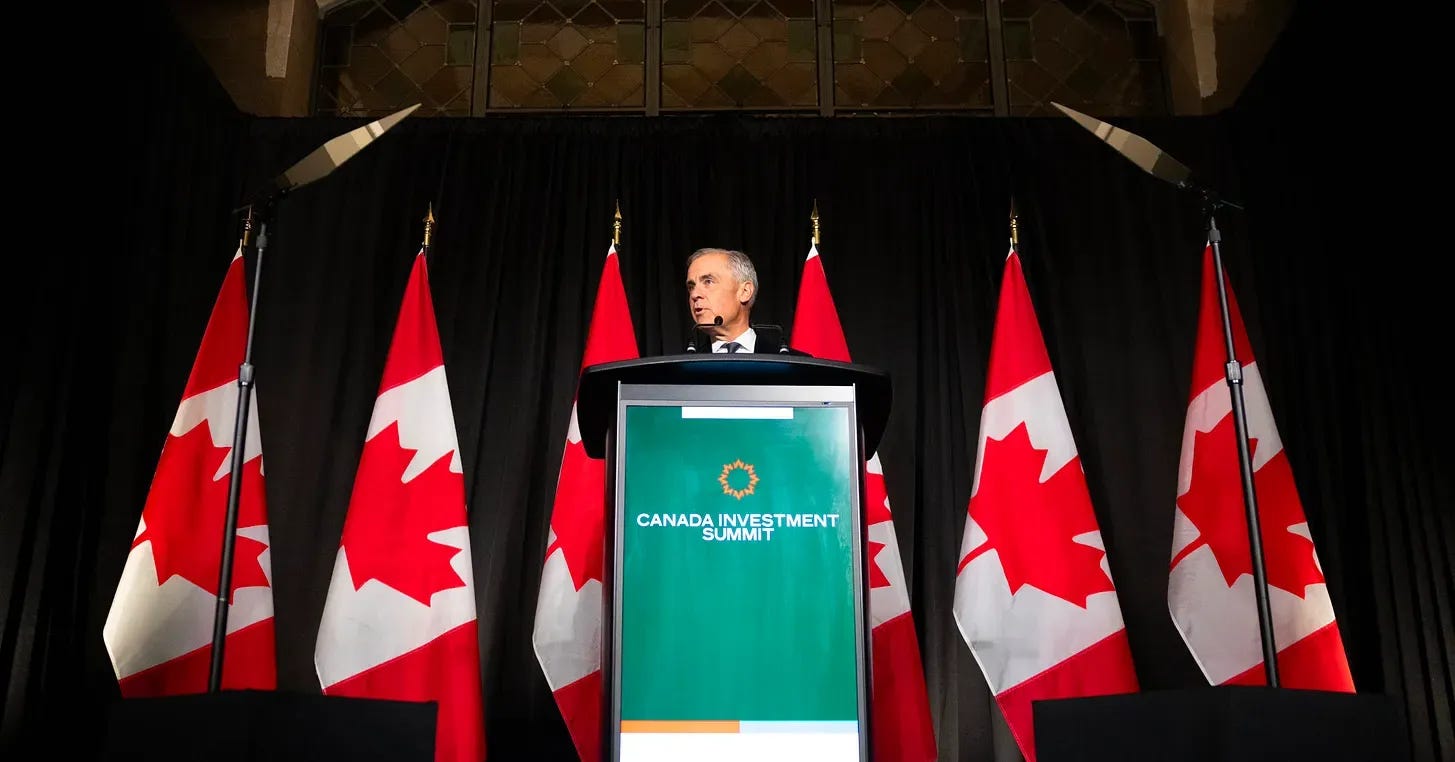
Prime Minister Mark Carney’s two-day Canada Investment Summit in Toronto is estimated to have cost the federal government $8.1 million. New parliamentary records show nearly $1.46 million in sole-sourced luxury hotel contracts and millions more in event production.
A November 23 response to an order paper question from Conservative MP Andrew Scheer revealed more than $1.4 million in federal expenses already incurred, with nearly $6.7 million in additional costs incurred or anticipated.
Invest in Canada listed $6,514,271 in “estimated remaining costs associated with event production” without providing a vendor-by-vendor breakdown.
“Figures are preliminary as costs listed in Part (e) continue to be processed,” the agency said.
Invest in Canada reported $479,247 in hospitality expenses incurred to date, with another $132,935 listed for a reception dinner. The Privy Council Office separately disclosed $42,618 in accommodation, travel and other expenses.
The parliamentary response also revealed that Invest in Canada awarded 10 of the 11 contracts without competitive bidding.
The largest was a $1,080,871 sole-sourced contract with Toronto’s Four Seasons hotel, followed by $189,000 for the St. Regis and $186,855 for the Hazelton.

The agency also awarded $202,724 in combined contracts for receptions at the Art Gallery of Ontario and the Royal Ontario Museum, alongside $49,584 for an event at the Park Hyatt Toronto.
Other sole-sourced contracts included $22,107 for a designer, $8,276 for an “Indigenous Drumming Performance,” $1,200 for an “Opening Prayer” and $827 for welcoming remarks.
The only competitively awarded contract disclosed was a $149,060 agreement with WPP Group Canada Communications ULC for design direction.
Asked whether it had posted a request for proposals, tender, or open competition on CanadaBuys, Invest in Canada responded: “No.”
The response did not explain the sole-sourcing decisions, while the Privy Council Office said it “has not identified contracts awarded in relation to the summit.”
Scheer specifically requested details of contracts awarded to E2K Events x Entertainment or its parent company, Olmstead Productions Inc., including the scope of their work and authorized subcontractors.
Neither company appeared among the disclosed contract recipients, despite the summit’s delegate privacy notice identifying California-based Olmstead Productions as the event’s producer, as first reported by the Toronto Sun.
The records do not establish who hired the American company, how much it was paid or whether any of the additional estimated production expenses are payable to it.
Invest in Canada and CPP Investments did not respond to questions from Juno News about the summit’s expenditures and procurement arrangements by publication time.
The Liberals’ spring economic update proposed $10.6 million to deliver the September 14 and 15 summit, according to Finance Department briefing documents. Carney hosted the event in partnership with CPP Investments and PSP Investments.
Following the summit, Carney touted nearly half a trillion dollars in investment commitments.
“We unleashed nearly $500 billion of new investment into Canadian businesses and infrastructure – and this is just the beginning,” Carney said in a September 15 news release.
However, another order paper response, tabled November 23 in response to Conservative MP Kelly McCauley, revealed that approximately two-thirds of the announced commitments came from just three Canadian banks.
Those included $150 billion in financing from TD over five years, more than $100 billion from Scotiabank over five years and $70 billion in investment and capital mobilization from BMO over a decade.
Of the $480.84 billion in announced commitments identified by the government, $427.5 billion came from Canadian pension plans, asset managers, and banks; $52.5 billion came from Bell Canada’s artificial intelligence infrastructure project in Saskatchewan; and $840 million came from federal funding announcements.
Asked which commitments were legally binding, the Privy Council Office acknowledged that commitments by asset managers seeking to mobilize capital would become legally binding once fundraising was completed and investments occurred.
“However, these agreements will take place between and among the investors and the companies, not with the Government of Canada,” the response reads.
The government said agreements involving financial institutions, companies and provincial governments were “outside the purview of the Government of Canada,” adding that commercial sensitivities could prevent their disclosure.
McCauley also asked how the government intended to track, verify and publicly report whether the announced commitments were fulfilled.
While the response outlined specific federal investment arrangements and existing oversight mechanisms for the Canada Growth Fund and Business Development Bank of Canada, it did not identify a comprehensive mechanism to track fulfillment of all announced commitments publicly.
The Liberals’ own November budget touted the summit as attracting investors from nearly 30 countries who collectively manage more than $100 trillion in assets, but included a caveat about the nearly $500 billion in announced commitments.
“Commitments span different financial activities and timeframes and should not be treated as directly comparable or additive,” the budget says.
With the summit’s final cost still unknown, Budget 2026 proposed another $181.4 million over four years beginning in 2027–28 to expand Invest in Canada, alongside $50.4 million in future years and $40.4 million in ongoing funding.
The funding would expand the agency’s financial sector expertise, international presence, and responsibilities.
“Invest in Canada will also deliver Canada’s future Investment Summits,” the budget reads.