

Author: Alex Dhaliwal
A Conservative MP is raising explosive allegations about Mark Carney’s corporate past, accusing him of ties to environmental destruction in Brazil and claims involving deforestation, Indigenous displacement, and slave-labour violations during his time at Brookfield Asset Management.
Steven Bonk says the accusations are so serious they raise fundamental questions about the Prime Minister’s credibility on climate policy, pointing to what he calls a stark gap between Carney’s global environmental rhetoric and his company’s record on the ground.
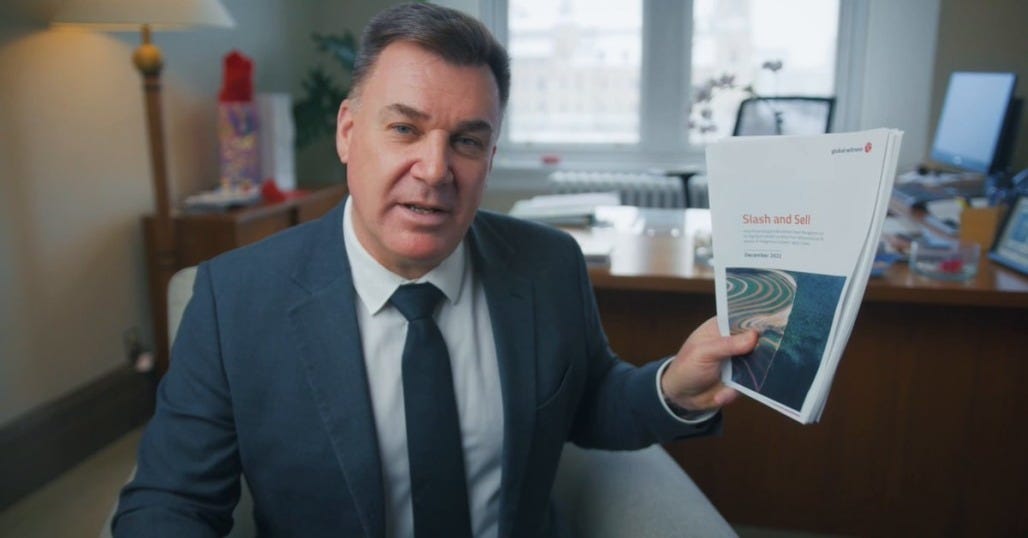
“I want to be very clear, these are very serious allegations: They include human rights abuses, accusations of slavery, deforestation of the rainforest,” Conservative MP Steven Bonk said Thursday in a video posted to X.

“I can’t believe that I’m having to clarify that Mark Carney, the Prime Minister of Canada, had or didn’t have slaves.”
According to Global Witness, Brookfield cleared 9,000 hectares of Brazilian forest for soy production between 2012 and 2021, producing emissions equivalent to 1.2 million London–New York flights.
The report Slash and Sell revealed Brookfield’s operations were also linked to an attempted Indigenous eviction and alleged violations of anti-slave-labour laws in the Cerrado.
As a senior Brookfield executive and UN climate envoy, Mark Carney oversaw the sale of deforested land linked to alleged human rights abuses and slave-like labour, despite previously arguing that companies should address environmental harm before divesting assets.

Before the UK Environmental Audit Committee in Oct. 2022, Carney said companies should address environmental harms through a “managed phase out” rather than selling problematic assets.
He reiterated this stance at COP27, saying: “Don’t divest your way out of the problem.”
But as Brookfield’s vice chair and head of transition investing, Carney oversaw the land sale and was later promoted to chair of its asset management division. Brookfield has not disclosed the sale price.
“This guy was trotting around the world with his elbows up, telling everyone that they need to reach net zero by 2050,” MP Bonk said.
“They have to drive an electric vehicle to save the environment while Mark Carney and Brookfield are leveling the rainforest.”
According to satellite imagery, Brookfield farms were linked to deforestation that reportedly generated about 600,000 tonnes of CO₂ emissions between 2012 and 2021, damaging the Cerrado, a key carbon sink and biodiversity hotspot.
Brookfield Asset Management also faced allegations of clearing critical forest for cash crops and attempting to displace Indigenous Peoples in the Amazon for cattle and mining development.
“This is all happening when Mark Carney wrote to members of GFANZ urging them to stop financing deforestation, warning the world will not reach net zero by 2050 unless we halt and reverse deforestation within a decade,” MP Bonk said.
Alongside his role at Brookfield Asset Management, Carney served as the UN Special Envoy on Climate Action and Finance, advised the UK government at COP26, and co-founded GFANZ, which calls on members to end deforestation financing.
“This couldn’t get any worse, and then you read the slave labour findings.
Global Witness says a Brookfield ranch sold in 2022 after a court freeze was linked to efforts to evict an endangered Indigenous community, and that a Brookfield-controlled firm was fined US$163,000 in 2021 for slave-labour violations at another farm. Carney was vice-chair at the time of the ruling.
According to court documents and media reports, police found 42 farm workers living in slave-like conditions at a farm in 2014, including 28 housed in a 70-square-metre building with no toilets or showers.
Brookfield has denied the allegations, saying it complied with all laws and regulations and is committed to the highest ethical standards.
“I don’t even know what to say,” said Bonk. “Can you imagine for one second if Pierre Poilievre or a company that he was connected to had these kinds of accusations against him? The legacy media would have lit their hair on fire.”
“Millions of people voted for Mark Carney because they thought he was a champion for the environment, for green energy. This could not be further from the truth.”
In September 2022, GFANZ, which was led by Carney, urged members to end deforestation financing and adopt deforestation-free supply chains by 2025. A month later, it dropped its Race to Zero requirement ahead of planned independent monitoring, raising accountability concerns.
A 2022 Global Witness analysis found GFANZ members held US$8.5 billion in investments in companies linked to deforestation despite net-zero pledges.
Veronica Oakeshott, the Forests Campaign Leader at Global Witness, argues that if companies tied to “green finance” leadership are failing on deforestation, it exposes weaknesses in a system built on voluntary corporate climate commitments under initiatives like GFANZ.
Brookfield Asset Management and its major banking backers—HSBC, Deutsche Bank, and Bank of America—joined GFANZ in April 2021, but have since withdrawn from the group.
Oakeshott called the Brookfield–GFANZ relationship a “troubled alliance,” while Brookfield said in 2022 it still supported Brazil’s “net-zero” transition.
The firm still holds tens of billions in Brazilian assets, including infrastructure, energy, gas pipelines, nuclear and hydroelectric plants, and shopping malls, but has exited mining and forestry.